
Indonesia is the largest economy in ASEAN and the world’s biggest Muslim consumer market. For Chinese food, cosmetics, and pharmaceutical companies, it represents a golden opportunity yet also a market with extremely high compliance barriers. With mandatory Halal certification fully enforced starting 17 October 2026, combined with Indonesia’s intensive new regulations on imports, labeling, and production controls introduced in 2025, compliance must be the top priority for Chinese enterprises seeking smooth market entry.
Based on Indonesia’s latest policies, this guide outlines key steps for market access, registration, and certification in concise and practical terms.
I. First Step to Enter Indonesia: Get Your Entity & Import Licensing Right
Establishing a legal business entity is the foundation of all compliance for official sales and imports in Indonesia.
1. Obtain a Business Identification Number (NIB)
Apply via Indonesia’s official OSS system. This is an essential document for legal operations and import licensing, without which no further procedures can proceed.
2. Choose the Correct Importer Type (API)
- API-U: Import finished goods for direct sales
- API-P: Import raw materials for in-house production
For long-term market development, it is recommended to establish a Foreign Investment Company (PT PMA) to hold import licenses independently, reducing reliance and risks associated with local agents.
3. Watch for “Trade Balance” Quota Restrictions
Since 2025, Indonesia has tightened import controls, placing certain foods, cosmetics, and raw materials under quota management. Companies must verify in advance whether their products are on the restricted list to avoid customs clearance failures.
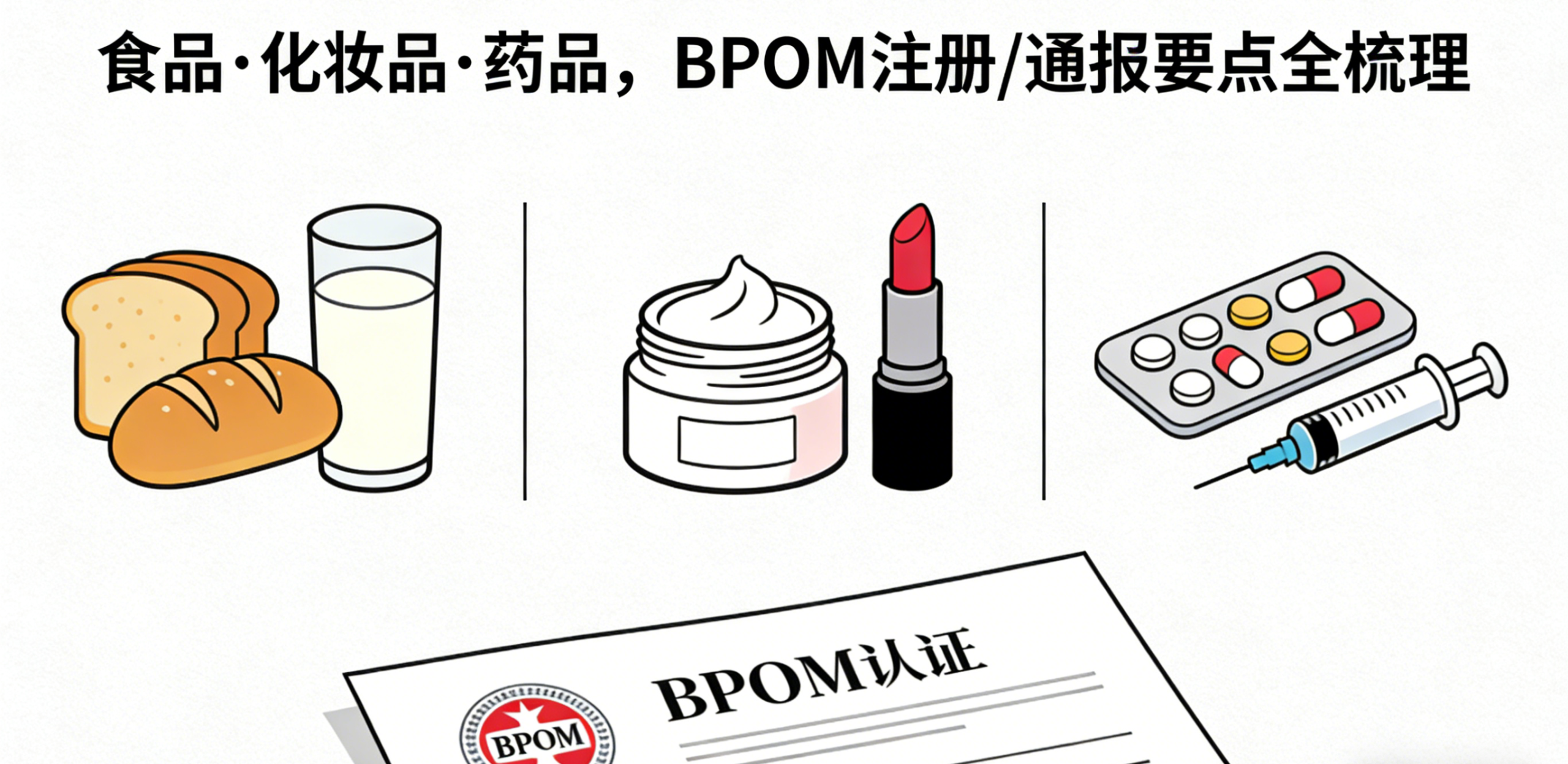
II. Compliance Focus for Three Major Categories: BPOM as the Core Regulator
Indonesia’s BPOM (National Agency of Drug and Food Control) regulates food, cosmetics, and pharmaceuticals with distinct requirements for each category.
1. Food: Strict Registration, Even Stricter Labeling
All processed food products (except short-shelf-life freshly prepared items) require BPOM registration. High-risk categories (infant formula, dairy products) may take up to 1 year for approval.
2025 labeling rules have been significantly tightened:
- Trans fat: Must be labeled if ≤0.5g/100g
- Tightened low-sugar standards: ≤3g/100g for solids, ≤1.5g/100g for liquids
- Claims such as “sugar-free” and “no added sugar” are prohibited to prevent misleading penalties
2. Cosmetics: Notification System + Prepared Documentation
Cosmetics are subject to pre-market notification, which must be held by a local Indonesian company.
Submit formulations, GMP certificates, Free Sale Certificates, and other documents to obtain a 3-year approval number.
Starting 2025, a Product Information File (PIF) must be prepared in advance for on-site inspections.
Ingredients such as retinoic acid and steroids are banned; retinol content is limited to ≤0.3%.
3. Pharmaceuticals: Strictest Supervision, Clinical Data Critical
Products are classified as prescription drugs, OTC, or traditional herbal medicines. The latter two require evidence of efficacy and safety.
Full clinical documentation is mandatory for registration; clinical trials must first pass ethical review and receive BPOM approval.
Chinese clinical data may be eligible for mutual recognition, but prior coordination and supplementary explanations on ethnic differences are required.
III. Industry Red Line: Mandatory Halal Certification Starting 2026
Halal certification is not optional — it is a legal requirement for market access.
1. Clear Enforcement Deadlines
- Food, cosmetics, personal care products: Mandatory certification from 17 October 2026
- Pharmaceuticals: To be implemented in phases at a later date; advance planning is still required
2. Certification & Mutual Recognition Shortcuts
Certificates are issued exclusively by BPJPH (Indonesian Ulema Council Halal Product Assurance Agency), covering ingredient review and on-site production audits to prevent non-Halal contamination.
Halal certificates issued by mutually recognized bodies in China or internationally may be registered in the SHLN system, waiving on-site audits and significantly speeding up approval.
3. Important Policy Clarification
Indonesia’s trade agreement with the does NOT exempt Halal certification. All products must still comply with Indonesian laws and obtain full certification.
IV. 4 Practical Recommendations for Chinese Enterprises
- Establish a local entity early: Secure NIB and API licenses to take control of imports.
- Prioritize certifications: Launch Halal and BPOM registration/notification simultaneously, allowing 3–12 months for processing.
- Design for compliance from R&D: Validate formulations, labeling, and ingredients against Indonesian standards during development to avoid reworks.
- Monitor policy updates: Indonesian regulations are still evolving; closely follow announcements from BPOM, BPJPH, and the Ministry of Trade.
Indonesia offers enormous market potential, but compliance is your entry ticket. By planning ahead and operating in full accordance with regulations, Chinese companies can firmly secure a position in ASEAN’s largest Muslim consumer market after the 2026 Halal certification deadline.
