Recently, self-media articles hyping that “Chinese enterprises dismantled entire battery production lines in Indonesia within three weeks and shipped all equipment back to China” have spread widely across major online platforms, gaining massive shares through extreme narratives and emotional rhetoric. Given that entrepreneurs with overseas investment plans are vulnerable to misleading content of this kind, this paper sorts out industrial facts, authoritative information and official statements to separate truth from rumors and establish a framework for identifying credible cross-border economic and trade information.
I. Fact-Checking Viral Online Claims: Partial Truths Grossly Exaggerated, Core Details Contradicting Industrial Norms
It is true that Indonesia adjusted its nickel ore mining quotas and updated policies supporting local industrial supporting sectors in 2026. Small and medium-sized battery supporting enterprises without self-owned mineral resources, which fully rely on externally sourced raw materials, have faced operational pressure. A small number of such firms dismantled lightweight precision processing equipment and transported it back to China to protect core technologies and revitalize fixed assets. This market-driven operational adjustment constitutes the only factual basis cited in the viral articles.
The core plots fabricated and overstated in the articles, including “leading Chinese-funded firms are withdrawing en masse with entire industrial zones emptied”, “complete dismantling of two-year-old full production lines finished in three weeks, every single screw shipped back home”, and “local merchants offered to buy equipment at 70% of the original price but were rejected by Chinese operators”, are evidently untrue and exaggerated, as elaborated below:
Leading Enterprises Continue Deep Local Investment with No Large-Scale Production Withdrawal
Industrial leaders including Tsingshan, Huayou Cobalt, GEM, and BRUNP (CATL’s Indonesian subsidiary) have invested billions of US dollars in heavy-asset projects in Indonesia, featuring smelting blast furnaces, self-owned power plants, deep-water terminals and other immovable heavy infrastructure. Dismantling and shipping such facilities incur exorbitant costs. These enterprises have only responded to policy fluctuations by cutting output or suspending expansion plans, and have never issued public announcements to dismantle core smelting production lines.
Engineering and Commercial Logic Discredit Extreme Descriptions
Factory civil engineering foundations, pipe networks and workshop frames are immovable real estate and cannot be relocated. The full dismantling, rust-proof treatment, customs declaration and ocean shipping cycle for a medium-sized battery production line generally exceeds 40 days, making the claim of full dismantling within three weeks inconsistent with industry standards. The ocean freight cost for ordinary standard hardware fittings far outweighs the value of the materials themselves; enterprises only recover customized special parts instead of shipping back every screw. Meanwhile, Indonesia’s local high-end battery equipment supporting market remains underdeveloped, eliminating the market foundation for local merchants to purchase second-hand equipment at 70% of original prices.
No Authoritative Sources Corroborate the Central Narrative
All relevant reports use vague references such as “a certain enterprise” and “industry insiders” without specifying project entities, timeframes or locations. Xinhua News Agency, CGTN, Reuters, Bloomberg, Indonesia’s Antara News and listed company announcements have never covered incidents of “full production line dismantling and repatriation”. Most attached images are spliced generic industrial stock photos lacking journalistic authenticity.
Such content represents typical clickbait articles that cherry-pick isolated cases of operational adjustments among small and medium-sized enterprises, overlay fabricated details to stoke confrontational sentiment, and easily distort overseas entrepreneurs’ objective judgment of Indonesia’s investment environment.
II. Practical Guidelines for Verifying Cross-Border Investment Information to Avoid Misinformation
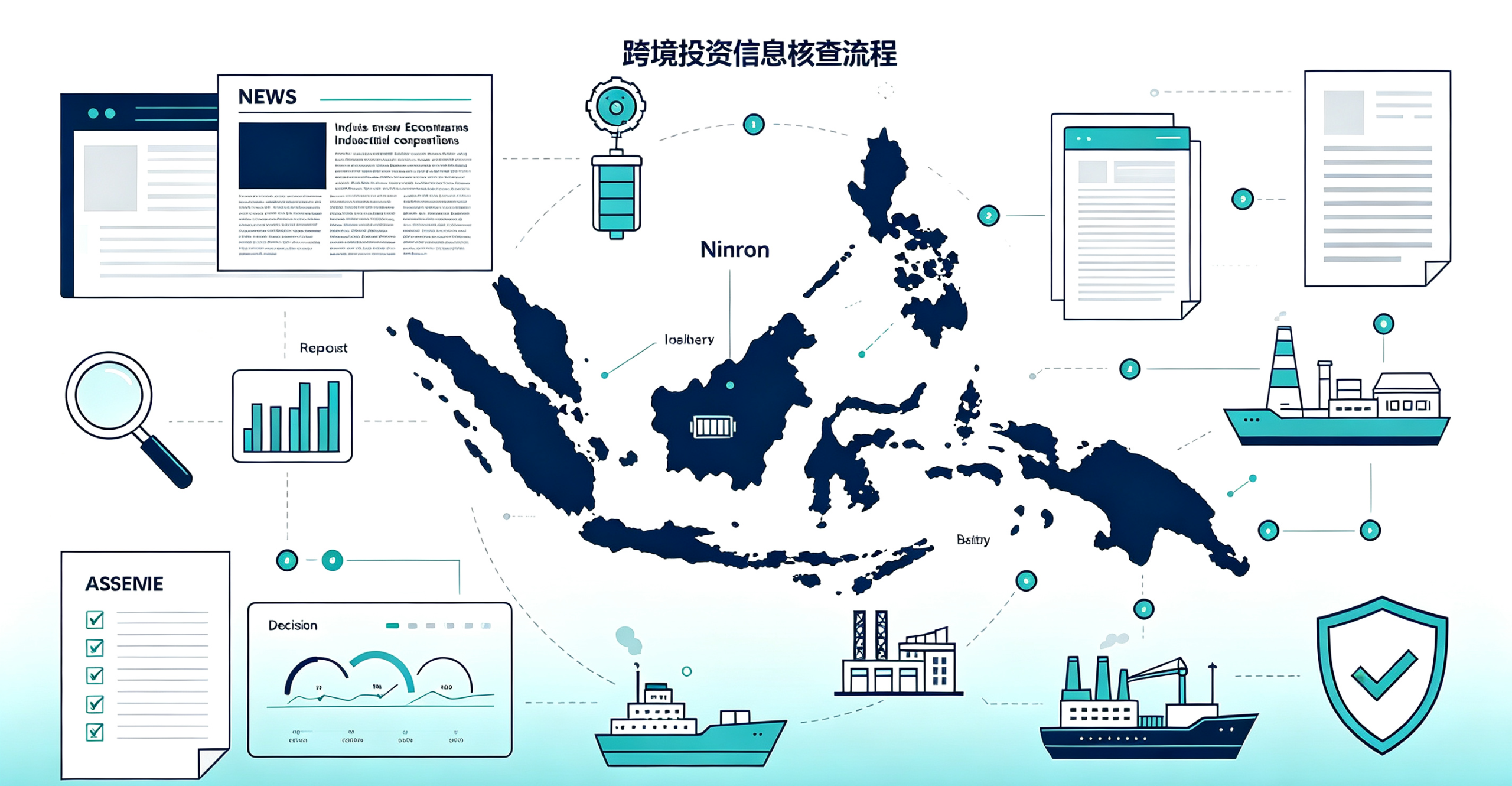
Four simple verification standards are compiled for overseas investors to quickly identify online rumors:
1. Prioritize Authoritative Information Sources
Credible channels include official announcements of listed companies, releases from the Ministry of Foreign Affairs and overseas commercial offices, national mainstream media, and official news agencies of host countries. Extra caution should be exercised with anonymous revelations from short-video creators, individual financial self-media and unverified community rumors. Formal industrial reports clearly specify three core elements: enterprises, industrial parks and timelines; any content relying entirely on vague references is highly suspect.
2. Cross-Validate with Three Layers of Logic
Remain alert to absolute modifiers such as “all”, “completely” and “in full”; distinguish relocatable precision equipment from real estate attached to land—claims that entire factories have been fully emptied are almost always overstated. Evaluate whether corporate actions align with commercial rationality by factoring in logistics, equipment procurement and labor costs.
3. Verify the Authenticity of Images and Video Footage
Use image recognition tools to cross-check pictures and videos attached to articles, differentiating generic stock materials from on-site footage of specific incidents. Research brokerage industry reports and industrial news across multiple channels. If identical narratives are circulated en masse solely by self-media without corroboration from authoritative outlets, the content can be confirmed as manipulated and exaggerated.
4. Cross-Check via Official Rumor-Refutation Platforms
Questionable information can be retrieved and verified through the China Joint Rumor Refutation Platform and rumor-busting columns of central media to avoid biased perceptions shaped by fragmented sensational narratives.
III. Latest Official Authoritative Remarks: China-Indonesia Economic and Trade Cooperation Delivers Mutual Benefits with Broad Prospects
On July 16, Foreign Ministry Spokesperson Lin Jian held a regular press conference and responded to media outlets that one-sidedly interpreted Indonesian leaders’ remarks on natural resources as targeting China:
“The Chinese side has noted relevant reports. Verification shows that interpretations by individual media outlets completely contradict the facts. China and Indonesia are friendly neighbors and vital development partners. The essence of bilateral economic, trade and investment cooperation lies in mutual benefit and win-win results. The Indonesian side has repeatedly expressed its expectation to deepen industrial and supply chain cooperation with China and welcomes Chinese-funded enterprises to invest in Indonesia. As two major developing countries, we believe China-Indonesia cooperation boasts broad prospects. We also trust Indonesia will continue to safeguard the legitimate rights and interests of Chinese-funded enterprises and foster a sound business environment for their investment and operations in Indonesia.”
IV. Take a Rational View of Adjustments to Overseas Industrial Policies and Establish a Long-Term Stable Investment Mindset
It is a universal norm in global industrial development for resource-rich countries to optimize domestic mineral and manufacturing policies. Chinese enterprises’ long-term deployment in Indonesia’s nickel industrial chain has boosted local employment, improved the full new energy supporting chain, and formed a mutually beneficial cooperation model. Self-media outlets deliberately amplify short-term policy shifts and construct binary confrontational narratives, which not only distort the real industrial landscape but also increase obstacles for Chinese enterprises operating locally overseas.
Overseas investors are advised to discard the emotional clickbait mindset when consuming cross-border industrial information. Judgments should be based on corporate announcements, official diplomatic statements and objective industry data, to clearly distinguish short-term policy adjustments from long-term investment value and rationally assess opportunities and risks of industrial layout in Southeast Asia. Faced with unsubstantiated extreme rumors, refrain from blind reposting and hasty judgment, and take the initiative to correct biased perceptions among contacts based on complete industrial facts.