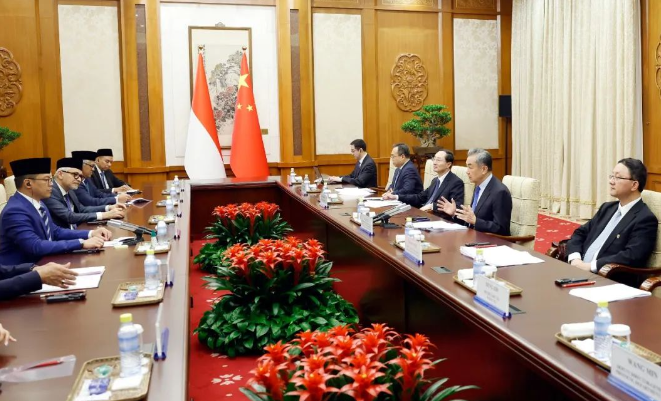
On April 21, 2025, China and Indonesia held a grand reception in Beijing to celebrate the 75th anniversary of the establishment of diplomatic relations and the 70th anniversary of the Bandung Conference. Wang Yi, a member of the Political Bureau of the CPC Central Committee and Minister of Foreign Affairs, and Defense Minister Dong Jun from China, along with Indonesian Foreign Minister Retno Marsudi and Defense Minister Prabowo Subianto, jointly attended the event. The first-ever “2+2” ministerial dialogue was held, signifying the continuous deepening of political trust and the comprehensive improvement of pragmatic cooperation between the two countries. This commemorative event is not only a tribute to the historical friendship but also a new starting point for promoting the building of a community with a shared future between China and Indonesia and deepening cooperation under the “Five Pillars” framework.
High-Level Leadership and Mechanism Innovation: Strategic Trust Consolidates the Foundation of Bilateral Relations
Under the strategic guidance of President Xi Jinping and President Joko Widodo, China-Indonesia relations are running at a high level. The two heads of state met twice last year and jointly established the significant consensus of building a community with a shared future that has regional and global influence.
The successful first meeting of the China-Indonesia “2+2” ministerial dialogue mechanism, along with the newly established comprehensive strategic dialogue mechanism, marks the entry of institutionalized cooperation in the fields of politics, security, and defense into a new phase. These high-level interactions and institutional constructions lay a solid political foundation for promoting the cooperation pattern under the “Five Pillars.”
Economic and Trade Cooperation: Building a High-Quality Win-Win New Plateau Together
China-Indonesia economic and trade cooperation is the core of the bilateral relationship. Wang Yi specifically mentioned that the two sides will continue to advance the Belt and Road cooperation, with major projects such as the Jakarta-Bandung High-Speed Railway further strengthening the interconnectivity between the two countries in the field of infrastructure. In addition, the two countries will also focus on high-quality joint construction of the Belt and Road, promoting in-depth cooperation in fields such as green energy and the digital economy.
Retno Marsudi emphasized that Indonesia has always regarded China as one of its most important partners and looks forward to deepening exchanges at all levels in the future, promoting the bilateral economic and trade relationship to develop in a higher quality and more efficient direction.
People’s Livelihood and Cultural Exchanges: Deepening People-to-People Bonds
While promoting economic and trade cooperation, China and Indonesia are also expanding the space for cooperation in new types of productive forces. The two sides will strengthen cooperation in the fields of scientific and technological innovation, digital economy, green transformation, low-altitude economy, marine and fishery, helping the two countries’ development models to transform towards high added value and sustainability.
On the other hand, China and Indonesia are also actively promoting pragmatic cooperation in the fields of food security, medical and health care, poverty reduction and disaster prevention, and rural revitalization. Cultural, educational, tourism, and youth exchanges are also being deepened in parallel, further consolidating the emotional bond of friendship between the two peoples for generations to come.
Promoting the Spirit of Bandung and Strengthening Solidarity and Cooperation among Global South Countries
Seventy years ago, China and Indonesia jointly promoted the Bandung Conference, for the first time, as developing countries, they voiced the call for peace, independence, and cooperation. Today, the two countries are once again joining hands to firmly uphold multilateralism in international affairs, oppose trade protectionism, and actively defend the common interests of developing countries.
Minister Wang Yi pointed out that as important forces in the Global South, China and Indonesia will continue to promote the Five Principles of Peaceful Coexistence and the “Bandung Spirit,” jointly maintain the multilateral trading system with the World Trade Organization at its core, and promote more fair and reasonable global economic governance.
Looking Ahead: Win-Win Cooperation and Moving Towards Common Prosperity
As China-Indonesia relations continue to deepen, future cooperation between the two countries will be broader and more far-reaching. The two sides will continue to strengthen cooperation in the fields of economy, science and technology, people’s livelihood, and especially in joint actions to address global issues such as climate change and promoting green development. Through these measures, the two countries will not only create more benefits for their peoples but also exert greater influence globally.
China-Indonesia cooperation is not only a model for bilateral relations but also sets an example of win-win cooperation for other developing countries globally, demonstrating the strong power of unity and common development among Global South countries.
Seize the Opportunity and Make a Move in Indonesia —— A Call to Action for Manufacturing Decision-Makers
In the current reshaping of the global trade landscape, inaction is the most costly strategy! As the largest economy in ASEAN, Indonesia is offering a “zero-time-difference” production start-up solution for manufacturers with a combination of national-level economic special zones and ready-made standardized factories:
-
Tariff Breakthrough
-
Cost-Locking Winning Strategy
-
Tax Policy: Companies in the special zones enjoy a 15-year corporate income tax exemption (full exemption for the first 5 years and a 50% reduction for the next 10 years), and import duties on equipment are fully exempted.
-
Labor Costs: The workforce under 25 years old accounts for 38%, with the average monthly wage in the manufacturing sector being only one-third of that in China.
-
Energy Assurance: The electricity price is approximately 0.5 RMB per kilowatt-hour, with peak hours at 0.75 RMB.
-
Employee Social Security: Health insurance is paid by both the employer and employee at 1% of the salary each, pension insurance is paid by the employer at 8.4% of the salary, and work injury insurance is paid by the employer at 0.24% of the salary. (Total less than 10%)
-
Ready-Made Factory Space for a Head Start
At this moment, what is rarer than a “cost valley” is a “strategic springboard” resource.
Please contact our investment promotion team immediately to obtain a customized implementation plan —— Starting when others hesitate is the true competitive edge!
Economic Special Zone Management Committee of Central Java, Indonesia
Bilingual (Chinese-English) Specialist Available 24/7 for 7 Days a Week