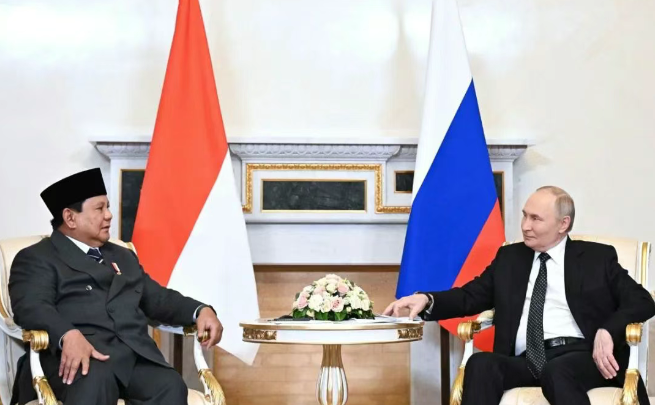
Indonesian President Prabowo Subianto had originally planned to attend the G7 summit in Canada, which concluded on June 17. However, he ultimately chose to accept an invitation from Russian President Vladimir Putin and departed for St. Petersburg on June 18. Indonesia’s diplomatic move of “abandoning the G7 for Russia” instantly captured global attention and was seen as a significant signal of a shift in Indonesia’s foreign policy towards diversification and embracing a multipolar world.
Praising China and Russia, subtly criticizing the West? Prabowo’s speech ignites public opinion.
At the highly anticipated 2025 St. Petersburg International Economic Forum (SPIEF), President Prabowo delivered a keynote speech. His powerful words quickly spread through social media platform Instagram, garnering tens of thousands of likes and enthusiastic comments from Indonesian netizens.
In his speech, Prabowo clearly stated: “China and Russia are countries that never practice double standards. They have always been fighting for justice, for the justice of all the world’s peoples!” This high praise for China and Russia was widely interpreted as an implicit criticism of the West’s long-standing “double standards” in foreign policy. Indonesian netizens reacted enthusiastically, excitedly commenting, “Indonesia has waited half a century to see a president with a firm stance again!”
Some analysts pointed out that although Prabowo openly acknowledged China and Russia, his wording was “clearly veiled,” directly targeting certain countries that practice double standards.
Putin’s “Friendship Offensive” and Substantive Cooperation Prabowo’s visit was by no means a symbolic courtesy call. The Russian side accorded him a very high-level reception and highly appraised the strategic significance of the visit, regarding it as an important opportunity to deepen bilateral relations.
On June 19, Putin held bilateral talks with Prabowo in St. Petersburg. Putin warmly addressed Prabowo as “my old friend” and launched a well-prepared “friendship offensive”: he presented Prabowo with the Russian translation of his own work “Military Leadership,” an exquisite officer’s sword, and Russian coins symbolizing the friendship between the two countries. In return, Prabowo gifted a Garuda statue representing the national spirit of Indonesia and a keris dagger, a specialty from Bali.
The outcomes of the talks far exceeded symbolic significance. The two countries signed several memoranda of cooperation on the same day, covering fields such as information and communication technology, transportation, and higher education.
More notably, Indonesia’s state investment agency Danantara and Russia’s Direct Investment Fund reached an agreement to jointly establish an investment platform worth up to 2 billion euros (approximately 16.5 billion yuan).
Putin emphasized that Indonesia is an important partner of Russia in the Asia-Pacific region and one of Russia’s largest trading partners in Southeast Asia. The scale of cooperation between the two sides in the fields of space, energy, defense, and agriculture is large and continues to grow.
Indonesia’s Strategic Shift: Embracing BRICS, Seeking Diversity Prabowo’s visit to Russia is the latest manifestation of Indonesia’s carefully constructed independent and diversified balanced foreign strategy in recent years. This strategic shift reached a climax on January 6, 2025, when Indonesia officially joined the BRICS mechanism.
At that time, the Indonesian Ministry of Foreign Affairs issued a statement, stating that this move “demonstrates Indonesia’s growing active role in global affairs and its commitment to strengthening multilateral cooperation and establishing a more inclusive and fair global order.”
Joining BRICS is of great strategic and economic significance to Indonesia. According to the director of the Center for Economic and Legal Research in Indonesia, the BRICS system can effectively help Indonesia “expand export channels and avoid over-reliance on Western markets.”
At the same time, in the field of security, facing a complex international situation, Indonesia also hopes to play a greater role in maintaining global balance through the BRICS platform.
“Surviving without the United States”? Indonesia’s Signal of Reducing Dependence on the West The signal of Indonesia’s pursuit of strategic autonomy and reduction of dependence on traditional Western countries is becoming increasingly clear. Just last week, Indonesia’s Minister of National Development Planning made a striking statement: Indonesia will no longer send negotiation teams to Washington, considering it a “waste of time and money.” The minister bluntly stated that the global economic structure is being restructured and that Indonesia will face a day when it can “get by without the United States.”
This statement, combined with Prabowo’s visit to Russia and the move to join BRICS, clearly outlines the contours of Indonesia’s foreign policy: firmly adhering to a “non-aligned” policy and actively expanding substantive cooperation with non-Western partners.
As Prabowo said in response to why he chose to attend SPIEF instead of the G7 summit: “It is not because I do not respect the Group of Seven, but because I want to show that I keep my promise (I had previously promised to attend SPIEF)… Indonesia has always adhered to a non-aligned policy. We respect all countries. Our foreign philosophy is very simple: a thousand friends are too few, and one enemy is already too many.”
A Model for Emerging Forces: Indonesia’s Demonstration in the Wave of Multipolarization The foreign policy choices of the Prabowo government provide a vivid example for all countries that do not want to take sides in the great power game. When the G7 tried to woo Indonesia to counterbalance China, Indonesia showed superb balancing skills:
On the one hand, China has maintained its position as Indonesia’s largest trading partner for several consecutive years (with bilateral trade reaching $92.79 billion in the first eight months of 2024), and it is the second-largest source of foreign investment. The jointly built Jakarta-Bandung High-Speed Railway is also a landmark project of the Belt and Road Initiative. On the other hand, Indonesia actively deepens its strategic partnership with Russia and other countries and expands the global South cooperation network through the BRICS platform.
Indonesia’s “abandoning the G7 for Russia” is not only a firm safeguarding of its own national interests but also a microcosm of the accelerated evolution of the global trend towards multipolarity.
It proclaims to the world: as the largest economy in Southeast Asia with a population of 280 million, Indonesia is striding forward with greater confidence on the international stage, forging its own independent path.