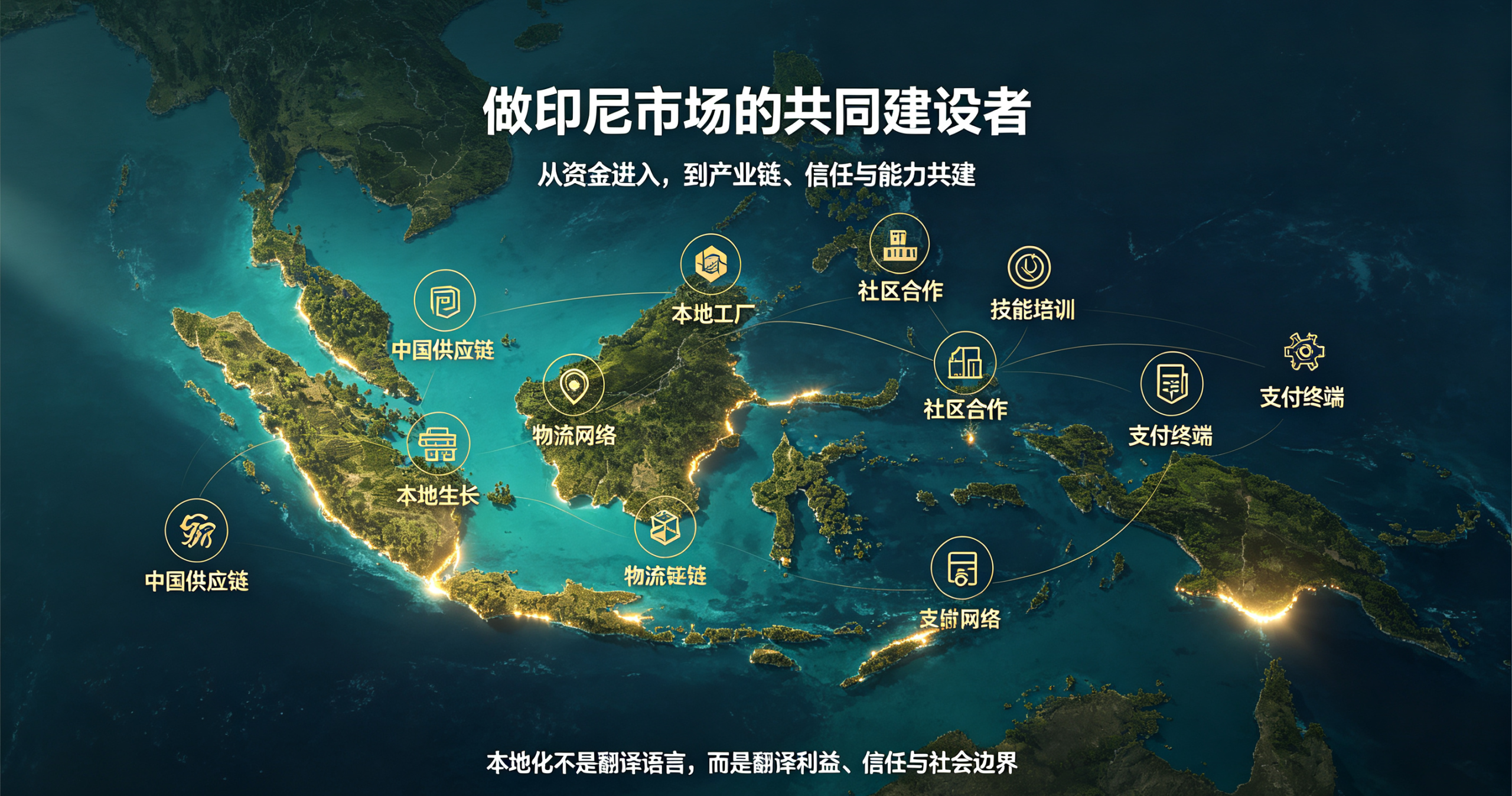
I. Introduction: Perception Shapes Direction, Maps Define Pathways
From our analysis in the previous part, we have reached a consensus: Indonesia is a market that demands in‑depth understanding rather than superficial coverage. While its demographic dividend and booming e‑commerce are undeniably appealing, genuine opportunities lie in a precise grasp of the country’s structural realities.
Today we lay out a practical framework built around “three maps”, designed to help you break free from homogeneous competition and chart your unique business course.
II. Map One: National Strategy Map — Sail With the Wind, Act in Tune With National Momentum
The top priority for overseas expansion is to align your overall direction with Indonesia’s national development rhythm. Enshrined in national planning is the Golden Indonesia 2045 vision. Its core drivers include downstream transformation of resource‑based industries, upgrading of manufacturing capacity, building digital economy infrastructure, green transition of the energy mix, and systematic improvement of human capital.
For foreign investors, the key is to identify resonance points between your business and national strategies. Instead of focusing solely on “what I want to sell”, ask yourself: Can my operations help Indonesian industries generate greater added value? Will my project equip local workers with stronger vocational skills? Can my investment enable local enterprises to move up the global supply chain?
Only when your commercial interests converge with long‑term national goals will policy support naturally act as a tailwind for your business.
III. Map Two: Archipelago Map — Reject One‑Size‑Fits‑All, Embrace Fragmentation
This is Indonesia’s most distinctive business map. It is critical to recognize: Indonesia is not one single market, but a collection of many markets. Consumption patterns in Jakarta cannot represent realities across Sumatra or Sulawesi. Logistics costs, income levels, cultural taboos and dealer behaviour can vary drastically from region to region.
Simply transplanting China’s centralized “headquarters‑provincial agent‑nationwide roll‑out” model frequently leads to severe cultural and operational mismatches.
A more pragmatic approach is point‑based breakthrough followed by ripple‑style expansion. You actually need three nested layers of mapping: first, national policy guidelines; second, the economic ecosystems of individual islands; third, channel networks within specific cities and townships. A prudent strategy is to select a representative city as your “showcase site”, fully validate a closed‑loop business model in one region, then use it as a base to replicate success gradually in neighbouring areas with similar cultural and consumption profiles.
IV. Map Three: Trust Map — Turn Local Partners Into Your Community of Shared Interests
While Indonesia’s online administrative systems such as OSS grow increasingly efficient, business still hinges fundamentally on human connections. Rules and institutions can be standardized, yet smooth commercial execution ultimately depends on building a multi‑layered, reliable local trust network.
Your network should include stakeholders who can interpret national policy trends, engage constructively with local governments, navigate community and religious sensitivities, and reach end‑customer channels down to the last mile.
Note that you do not need one omnipotent “super connector”. What you require is a partner matrix with clear division of labour, well‑defined responsibilities and shared benefits. Common interests and transparent rules form the foundation for the long‑term stability of this network.
V. Three Intersecting “Golden Corridors”
Overlay these three maps, and three promising opportunity corridors emerge clearly:
Corridor 1 (National Strategy + Archipelago Map): Downstream Industrial Supporting Services
As large‑scale resource projects roll out across the archipelago, substantial gaps open up for localized supporting services. Examples include specialised industrial logistics, environmental compliance consulting, digital park management, cold‑chain warehousing, and technical training for small‑and‑medium suppliers. These are not the main battlegrounds for industry giants, yet they represent excellent entry points that grow alongside major infrastructure development.
Corridor 2 (Archipelago Map + Trust Map): Regional Brand Operators
Since brand owners can hardly manage end‑to‑end operations across every island themselves, service providers who deliver localised messaging, refined regional dealer management, community‑driven private‑domain operations and region‑specific product specification design deliver scarce value. Your role is more than a simple goods transporter: you effectively translate China’s robust supply‑chain capabilities into value that Indonesian consumers across regions are willing to pay for.
Corridor 3 (National Strategy + Trust Map): Digital Empowerment for Micro‑and‑Small Merchants
Indonesia’s national QRIS QR‑code payment system covers over 39 million micro, small and medium‑sized merchants. Widespread payment adoption is only the starting point. These merchants have growing, long‑tail demands for deeper operational digitisation: business analytics, inventory and procurement management, micro‑financing, tax compliance, and even AI‑powered content generation. This represents an extensive, long‑term market track.
VI. Conclusion: Deepen One Sea Rather Than Map the Entire Ocean
Indonesia’s business landscape is made up of countless local realities. Here you must learn to deepen your presence before pursuing scale.
Success is measured not by how broad your coverage is, but by how deep your roots grow. It manifests in your relationships with local communities, your commitment to local partners’ interests, and tangible added value you bring to domestic industries.
Your true competitive moat for the future lies in building an inimitable, bespoke business course — shaped by national strategy trends, archipelagic network nodes, and human‑centred trust.
To all business navigators: may you ride the winds and waves in this dynamic archipelagic nation, advancing steadily toward lasting success.