
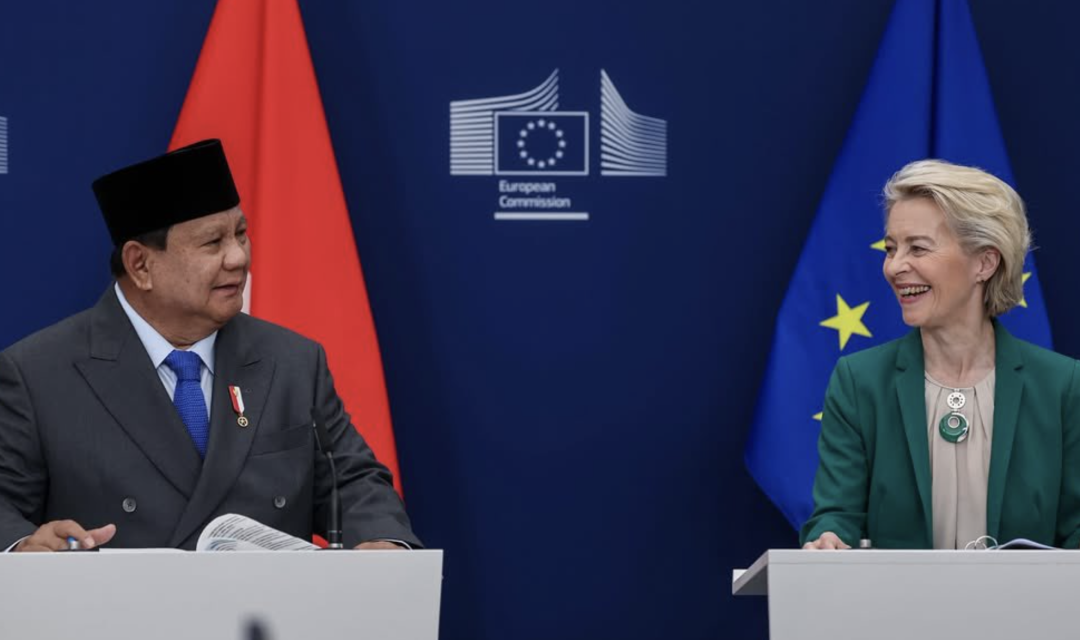
Brussels, 13 July – Indonesian President Prabowo Subianto and European Commission President Ursula von der Leyen met in Brussels today and announced that, after nine years and 19 negotiating rounds, the Indonesia–EU Comprehensive Economic Partnership Agreement (IEU-CEPA) has reached political consensus, formally closing the negotiations.
Speaking at a joint press conference, President Prabowo said: “Following nearly a decade of talks, we have agreed on a comprehensive economic partnership—essentially a free-trade agreement. We have balanced our economic interests across many provisions and achieved a mutually beneficial outcome.”
European Commission President Von der Leyen added: “Much of the potential in EU–Indonesia trade remains untapped. This agreement comes at the right moment; it will open new markets for both sides and propel our economic relationship forward.”
Against a backdrop of rising global uncertainty, the IEU-CEPA carries broad strategic significance. Its implementation is expected to deliver multiple benefits:
Boost exports: Upon entry into force, about 80 % of Indonesian exports will enter the EU duty-free, notably palm oil, fisheries, renewable-energy products and electric vehicles.
Strengthen investment confidence: The deal will bolster international trust in Indonesia’s legal and business environment, attracting more strategic European investment and providing foreign firms with a more stable and attractive market.
Advance key sectors: Indonesian textiles, furniture and other labour-intensive industries will gain competitiveness through tariff reductions, creating jobs and easing current employment pressures.
Diversify trade partners: Amid volatile global trade patterns, the agreement will help Indonesia diversify its markets, reduce dependence on any single partner and enhance economic resilience.
With IEU-CEPA concluded, Indonesia–EU cooperation enters a new phase. Indonesian exports to the EU are projected to rise markedly in the coming years, injecting fresh momentum into the Indonesian economy.
The accord will not only sharpen Indonesia’s global competitiveness but also lend broader confidence to the world economy, steering international trade toward greater openness, freedom and diversification.

